Friday, November 13, 2009

I (don't?) Know Where You Live!

Chances are, if you're an American, you will have moved to another house, city or country by the time you're finished reading this post.

And don't think I'm just pointing fingers. My family moved every 5 or 6 years from the time I was born until I moved out of the house. And I followed in my parent's footsteps by making my own - right out of the country. Petra and I have lived in 5 different cities, 6 different apartments or houses and on 2 continents in our 4 years of marriage.

But what made me notice the trend was our address book. We have crossed out and written in so many addresses of our American friends that we need a new address book. The gracious 2 address slots that were provided for any individual or family have been used up in many cases.

Croatians on the other hand don't move. The dependency on family, the current financial situation and traditional values that exist here in Eastern Europe keep most in the village, town or city they were born in. Even after marriage many couples move into one of the parents' houses.

Maybe you could say Croats are like the stubborn donkeys who dig their hooves into the mud all along the Dalmation Coast. Or maybe they're the smart ones who would rather not bother with all the stress that comes with changing locations.

Either way, I've found that to become Croatian means to stay put. With the beauty, hospitality and cuisine we've experienced so far, I'm planning on it - at least for a little while.

Tuesday, November 10, 2009

Learning the Hard Way

It is no secret - learning Croatian has been extremely difficult for me. As I mentioned earlier, being shy hasn't helped, nor has the eagerness of many Croatians to practice their English with me.

But in my struggle to learn how to learn Croatian, I've realized the best way is to act like I know Croatian. Crazy, but true.

Before I realized this concept, I often acted as if I had to humbly apologize for my bumbling tongue before beginning whatever it was I had to say. Whether I was talking to a cashier, an acquaintance or a drunk man at the cemetary, I was constantly self-conscious of my grammatical ineptitude. And everyone could tell.

But the other day, I confidently walked into the book store, asked for 60 envelopes, a poster board and several copies. I probably made 5 grammatical errors in the process. But I received everything I asked for along with a compliment "Dobro ide!" ('it's going well' - referring to my progress in language learning) and a smile.

I thanked the lady for the pleasant words and realized the whole acting thing was a good idea.

As I thought about the exchange, and my new approach to learning Croatian, I remembered that C.S. Lewis talked about this sort of concept in Mere Christianity:

"Do not waste time bothering whether you 'love' your neighbor, act as if you did. As soon as we do this we find one of the great secrets. When you are behaving as if you loved someone, you will presently come to love him. If you injure someone you dislike, you will find yourself disliking him more. If you do him a good turn you find yourself disliking him less."

___________________________________________________

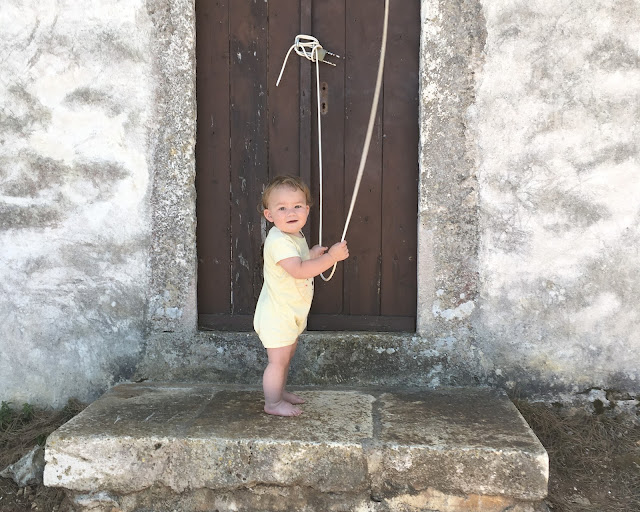
Enoh's not concerned about the fact that he doesn't know how to walk like me yet. He just walks the best he can. And you know what? The process of "acting" like he can walk will naturally turn him into a professional walker. Nor does he care that he can't say "goodnight" yet, his "Ny, Ny" communicates just as well.

Whether it's learning a language or how to live like Christ, I'm finding that action has a big part to play in the process. Thankfully I have a child who's helping me learn.

Saturday, November 7, 2009

Learning the Easy Way

It's been 3 months since I updated daddy's blog and though I sleep 12 hours a night (and 3 during the day) when I'm awake I'm a bustle of activity. One Croatian friend even called me a "mala vatra" (little fire). I've been using my time wisely though:

I've been learning how to eat:
And how not to:How to walk: And how to fall: How to clean:And how to make a mess:
I've also been learning how to become a real Eastern European:
How to read:
And how to pose for pictures:

Tuesday, November 3, 2009

McShock

I may have touched on this in an earlier post, but it is worth repeating.

If you are looking for a fine family restaraunt in the country of Croatia; if you want a place where you know the food is fresh, the kitchen is clean and the servers are sweet - then McDonalds is your place.

The first time I stepped into a McDonalds in Croatia I was shocked by the size of a "large" Coke. But after I slurped it down I noticed that families were sitting and eating together. I saw clean floors. I witnessed friendly cashiers. I saw expensive looking chairs. And apparently that wasn't good enough for them. That particular McDonalds has recently been refurbished with 2 flatscreen televisions and a brand new play area.

Why all of this?

A friend of ours, who was fired from McDonalds for using the wrong kind of cleaning sponge on the floor answered that question: "They told us this place has to be perfect in order to protect the American reputation. We have to be nicer than anyone else. We have to clean better than anyone. We even take toothbrushes to the space between the tiles!"

And what do the workers think about working there? Another acquaintance told us "It's the best working envirnonment I've been in. Everyone is so friendly, the pay is great and I feel like I have a purpose when I go to work."

If that's not culture shock for you I don't know what is.

Thursday, October 22, 2009

Good Leadership

I came across this post on my friend Milo's blog the other day. Whether you're Croatian or American, good leadership can be refreshingly shocking. Milo's observations are valuable to anyone serving as a leader in any capacity:

I have spent the last 5 months in the Intensive care unit with my little boy Josiah Nathaniel. During this time, I have witnessed some things that can learned about leadership, and a working environment that may be helpful to your organization.

1. Everyone understands the chain of command, and the appropriate relationships within that chain.
2. The collective opinion of the leadership group is of great worth and value to those who answer to them.
3. Disagreements of opinions by those in leadership are resolved behind closed doors, then presented as a unified decision.
4. The opinion of those involved in the day to day work/care (i.e.. parents and bedside nurses) is regularly evaluated and listened to.
5. Every doctor and nurse has a training time when they arrive, but after that they are expected and encouraged to make their own decisions, and carry their own weight.

Numbers 6-10 here.

Saturday, October 17, 2009

Hooked on Phonics

There's nothing better in language learning than a nice phonetic alphabet to get you started. Just ask anyone learning Croatian. As soon as you know the alphabet, theoretically you know how to pronounce every word in the dictionary.

So before I even moved to Croatia I was pronouncing Croatian words. After we moved, when I attended church, I was singing along to all the worship songs. I didn't have the slightest clue what they were singing about (unless it was a translated song) but I sang nonetheless.

But if you've grown up on a steady diet of phonetic letters, the English alphabet will feel like a punch in the gut.

The first English class I ever taught here was a lesson in this fact. I was going through the alphabet with some adult beginners. After I had shattered everything they knew about the letter A, there was one lady who became increasingly frustrated. Finally at "W" she lost it. At the time I had no idea what she was saying, but later one of the students told Petra what had happened and Petra translated:

"She was cursing you out Jeremy", Petra said laughing. "She couldn't figure out how it was called "double-U" when it looks like "double-V" and she definitely couldn't understand how if the letter starts with a "d" sound (Double-U) how the word "window" starts with a sound she can't even make!" (There's no "wh" sound in Croatian.)

And the lady never recovered. She came a few more weeks but then dropped the class altogether. Fortunately others have been a bit more patient, and thankfully I've learned how to deal with the fear and trembling that comes with the English alphabet since, but the problem makes sense. Consider the following:

Did you know that GHOTI could be pronounced like "fish"?

- If you take the GH from "enough" that gives you the "f" sound.
- The O from "women" gives you the "i" sound.
- And the TI from "nation is the same as "sh" in fish.

It's no wonder English learners have a hard time figuring out how to pronounce words. Anyone for a phonetic English alphabet?

Thursday, October 15, 2009

ID Please

Petra and I have had the opportunity to guest-teach English in the local High School here in Orahovica this fall. One of the topics we used to get students talking was "culture shock". What does it mean? We followed that conversation with an activity where the students had to come up with 3 things Americans would be shocked at here in Croatia.

Just about every class brought up alchohol. Some mentioned that Americans would be blown away by the strength of Croatian "rakija". Others noted how many people drink in Croatia. One person mentioned the legal drinking age (18) which is not strictly enforced.

And that's true. If I know where I could find underage drinkers on any given Saturday night, I'm sure the police do too.

But it got me thinking about the "legal age" a person has to be in order to do something.

For example, in Iowa, a 15 year old can get their permit to drive. Here you have to be at least 18 and pay an arm and a leg for that privelege.

In America you can't legally drink until you're 21. And you know what? That's not necessarily a bad thing. But think of all the things you can do (legally) at 18.

One friend in Croatia thought it seemed strange that an American 18 year old is allowed to join the military, kill someone in another country and come back to a celebration. But they're not allowed to have a drink. They may have a point.

On the other side of the ocean, Croatian law inforcement could easily lower the underage drinking rate. But what brings in the most money here? Bars, cafes and discos. Why stop now?

What dictates the legal age in a given country? Values? Money? Tradition?